
You already know a laser cutting machine can slice through sheet metal. But if you are investing six figures in a piece of equipment, or sourcing one for your distribution network, you need a sharper picture than that. What exactly do people make with a laser cutting machine once it arrives on the shop floor? Which industries depend on laser cutting, and why did they choose laser over plasma, waterjet, or punching?
This article answers those questions with specifics. We walk through more than 25 documented laser cutting machine uses spanning automotive, construction, agriculture, furniture, kitchenware, energy, electronics, and beyond. Along the way, we explain why laser cutting is the preferred process for each application — not in abstract marketing language, but in terms of the material, thickness, tolerance, edge finish, and production speed that each job actually demands.
If you are evaluating a laser cutting machine purchase, this is also a useful exercise in market sizing: every application listed here represents a category of customers who need the parts only a laser cutting machine can efficiently produce.
Automotive Manufacturing: Where Speed and Precision Meet
The automotive industry is one of the largest consumers of laser cutting technology worldwide, and the range of laser cutting machine uses within a single vehicle is remarkable.
Body Panels and Structural Components
Laser cutting machines process the flat blanks that are subsequently stamped into doors, hoods, fenders, floor pans, and roof panels. Automotive-grade steel sheet (typically 0.7 mm to 2.0 mm thick) requires extremely tight dimensional tolerances on the blank because any deviation is amplified during the stamping process. Fiber laser cutting machines operating at 4–6 kW cut these blanks at speeds of 15–40 meters per minute with positioning accuracy of ±0.05 mm — performance that mechanical shearing and blanking presses struggle to match on complex non-rectangular shapes. Fully automatic laser blanking lines that feed directly from steel coil have become standard in Tier 1 automotive stamping plants, replacing traditional blanking presses entirely for many part geometries.
Chassis and Frame Parts
Truck frames, subframes, cross members, and suspension brackets are laser-cut from high-strength low-alloy (HSLA) steel plate ranging from 3 mm to 12 mm. These parts require precise hole patterns, slot geometries, and contour profiles that mate with other components during assembly. A laser cutting machine delivers these features in a single setup with no secondary drilling or punching operations, reducing both labor and dimensional variability.
Exhaust Systems and Heat Shields
Stainless steel exhaust components — manifold flanges, catalytic converter shells, muffler baffles, and heat shields — are among the most common laser cutting machine uses in automotive Tier 2 and Tier 3 suppliers. These parts are typically 1.0 mm to 3.0 mm stainless steel, cut with nitrogen assist gas to produce the oxide-free edges required for subsequent welding operations. The narrow kerf and minimal heat distortion of laser cutting are critical advantages: a warped exhaust flange will not seal properly against the engine block.
EV Battery Trays and Enclosures
The rapid growth of electric vehicle production has created a significant new category of laser cutting machine uses. Battery tray components, cooling plate blanks, and structural enclosure panels are typically cut from 2 mm to 6 mm aluminum alloy sheet. Fiber laser cutting machines handle aluminum efficiently thanks to the high absorption of the 1,070 nm fiber laser wavelength by aluminum. The precision of laser cutting is essential because battery tray assemblies must meet strict dimensional specifications for crash safety certification.
Construction and Structural Steel Fabrication
Structural steel fabrication shops were among the earliest adopters of CNC laser cutting, and the range of laser cutting machine uses in this sector continues to expand as laser power levels increase.
Beam Connection Plates and Gussets
Every structural steel connection requires plates with precisely positioned bolt hole patterns. A laser cutting machine can cut a gusset plate with 20 bolt holes in the time it takes a drill press to complete two. For steel fabricators handling hundreds of unique connection details per project, the CNC flexibility of a laser cutting machine eliminates the need for custom drill jigs and dramatically reduces lead times. Materials range from 6 mm to 25 mm mild steel plate, well within the capacity of a 6–12 kW fiber laser cutting machine.
Staircase Stringers, Handrails, and Decorative Metalwork
Architectural steelwork increasingly features complex cut profiles — curved stringer plates, perforated decorative panels, and custom bracket designs that would be impractical to produce with traditional methods. Laser cutting machines make these designs economically feasible even in quantities of one or two, because there is no tooling cost and the programming time is minimal.
Tube and Pipe Processing for Steel Structures
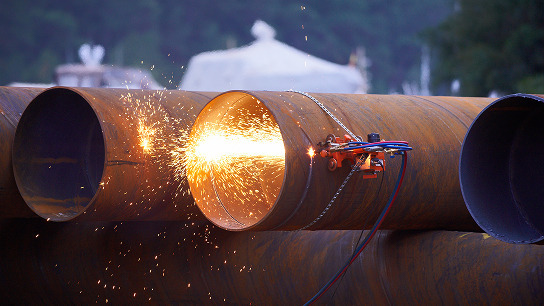
Laser pipe cutting machines have opened up a category of structural connections that were previously expensive and labor-intensive to fabricate. Coped tube joints (where the end of one tube is profiled to fit precisely against the curved surface of another), slotted connection details, and complex notch geometries can all be cut automatically on a laser pipe cutting machine. This is one of the fastest-growing laser cutting machine uses in the construction sector, particularly for architecturally exposed structural steel (AESS) where joint appearance matters.
Agricultural and Heavy Equipment Manufacturing
Agricultural machinery, mining equipment, forestry equipment, and material handling systems all rely heavily on laser-cut components. The laser cutting machine uses in this sector tend to involve thicker materials, larger part sizes, and rugged functional requirements.
• Combine harvester components: Header plates, feeder house panels, separator screens with complex slot patterns, and structural frames. Materials include 3–16 mm mild steel and Hardox wear-resistant plate.
• Tractor and implement frames: Drawbar brackets, three-point hitch assemblies, and loader arm plates. Laser cutting enables the tight-tolerance bolt patterns and interlocking tab-and-slot features that speed up welding assembly and improve structural consistency.
• Conveyor and material handling parts: Side plates, flight bars, sprocket blanks, and chute liners. Laser cutting machines process these from 6–25 mm plate with the consistency needed for interchangeable spare parts across large equipment fleets.
• Tillage and ground-engaging tools: Disc blanks, sweep blades, and cultivator points cut from hardened steel and boron steel plate. These are demanding laser cutting applications due to the hard, abrasive material, but high-power fiber laser cutting machines (12 kW+) handle them effectively.
For agricultural equipment manufacturers, the key laser cutting advantage is flexibility. Product models change frequently, production runs may be small (hundreds rather than thousands), and each model has dozens of unique cut parts. A CNC laser cutting machine can switch between different part programs in seconds with zero tooling changeover, which is a significant advantage over plasma cutting (lower precision on smaller features) or punching (requires custom tooling for each part).
Sheet Metal Fabrication: The Broadest Category of Laser Cutting Machine Uses
General sheet metal fabrication shops represent the single largest market segment for laser cutting machines, and the diversity of parts they produce is enormous. Nearly anything made from flat sheet metal — enclosures, brackets, panels, chassis, housings, covers, frames, guards, and structural components — passes through a laser cutting machine before bending, welding, and finishing.
Electrical Enclosures and Control Cabinets
Electrical panel enclosures are one of the highest-volume laser cutting machine uses worldwide. A typical control cabinet requires multiple flat panels with cutouts for switches, displays, ventilation louvers, cable entries, and mounting holes, all cut to tolerances of ±0.1 mm or better. The panels are then bent on a press brake or panel bender to form the box shape. Laser cutting is the ideal first step because it handles all of these features in a single program, on materials from 1.0 mm to 3.0 mm mild steel, stainless steel, or aluminum.
HVAC Ductwork and Components
Heating, ventilation, and air conditioning systems use large volumes of laser-cut galvanized steel and stainless steel sheet, typically 0.6 mm to 1.5 mm thick. Duct flanges, transition pieces, damper blades, and diffuser faceplates are all standard laser cutting machine uses. The speed of laser cutting on thin galvanized sheet is exceptionally high — a 3 kW fiber laser cutting machine can cut 1.0 mm galvanized steel at over 30 meters per minute.
Signage and Architectural Panels
Decorative metal signage, building facade panels, elevator door panels, and interior design elements are increasingly produced on laser cutting machines. Stainless steel, aluminum, and Corten steel (weathering steel) are common materials. The ability of a laser cutting machine to cut intricate lettering, logos, and geometric patterns with smooth edges and no tool marks makes it the natural choice for visual-quality metalwork.
Kitchenware, Food Equipment, and Stainless Steel Products
The food industry has strict requirements for hygiene, corrosion resistance, and surface finish, which makes stainless steel the default material and laser cutting the preferred fabrication process. Laser cutting machine uses in this sector include:
• Commercial kitchen equipment: Worktable tops, sink basins, splashback panels, and hood canopy components — all laser-cut from 1.0–3.0 mm 304 or 316 stainless steel with nitrogen assist gas to produce the clean, oxide-free edges essential for food-contact surfaces.
• Food processing machinery: Conveyor side frames, hopper panels, mixing chamber housings, and packaging machine components. Many of these parts have complex contours and numerous small features (sensor holes, bearing mounts, slot patterns) that are only practical to produce with a laser cutting machine.
• Cookware and bakeware blanks: Disc blanks for pots, pans, and baking trays cut from stainless steel and aluminum sheet. The dimensional consistency of laser-cut blanks ensures uniform depth after subsequent deep drawing or spinning operations.
• Beverage and dairy processing: Tank shell blanks, manway flanges, valve mounting plates, and instrument connection bosses. These parts often require traceability marking, which a laser cutting machine can apply in the same setup as the cutting operation using a low-power engraving mode.
For stainless steel fabricators serving the food industry, nitrogen-assist fiber laser cutting is essentially non-negotiable. The oxide-free edge finish eliminates the need for post-cut grinding and ensures that welded joints meet the surface smoothness standards required by food safety regulations (such as 3-A Sanitary Standards). This is one of the laser cutting machine uses where the process advantage is not just about speed or cost, but about achieving a technical requirement that alternative cutting methods cannot reliably deliver.
Energy, Power Generation, and Pressure Vessel Fabrication
The energy sector — including oil and gas, renewable energy, and conventional power generation — consumes large quantities of laser-cut metal components across a wide thickness range.
Wind Turbine Components
Tower shell blanks (typically 10–30 mm structural steel plate), internal platform brackets, ladder rungs, and flange ring segments are all established laser cutting machine uses. The dimensional accuracy of laser-cut tower shell blanks reduces fit-up time during the rolling and welding operations that form the cylindrical tower sections. As wind turbines continue to grow in size, the demand for high-power laser cutting machines (12–30 kW) capable of processing 20–40 mm plate at production speeds has increased significantly.
Solar Panel Mounting Structures
Ground-mount and rooftop solar racking systems use high volumes of laser-cut galvanized steel and aluminum profiles. Bracket plates, clamp components, and rail splice plates are typically 2–6 mm and are produced in large quantities with tight tolerances for field assembly. The CNC repeatability of a laser cutting machine ensures that every bracket in a run of 10,000 pieces is dimensionally identical, which is essential when installers assemble systems in the field without on-site machining.
Pressure Vessel and Boiler Components
Shell blanks, head blanks (before dishing), nozzle reinforcement pads, saddle plates, and baffle plates for pressure vessels and heat exchangers are common laser cutting machine uses in this sector. Materials include carbon steel (SA516 Gr.70), stainless steel (304/316L), and alloy steel plate up to 40 mm thick. The clean cut edges from laser cutting reduce or eliminate the edge preparation grinding that is otherwise required before welding to pressure vessel codes (ASME Section VIII, PED).
Quick Reference: Laser Cutting Machine Uses by Industry and Material
The following table summarizes the most common laser cutting machine uses organized by industry sector, typical materials, thickness ranges, and the specific advantage that laser cutting provides in each application:
| Industry | Typical Parts | Material | Thickness | Why Laser Cutting? |
| Automotive | Body blanks, chassis plates, exhaust flanges, EV battery trays | Mild steel, stainless, aluminum | 0.7–12 mm | Speed, precision for stamping, complex shapes |
| Construction | Gussets, beam plates, stair stringers, decorative panels | Mild steel, Corten | 3–25 mm | CNC flexibility, zero tooling, fast turnaround |
| Agriculture / Heavy Equipment | Frame plates, implement parts, wear parts, conveyor components | Mild steel, Hardox, boron steel | 3–25 mm | Small batch flexibility, tight bolt patterns |
| Sheet Metal Fabrication | Enclosures, brackets, panels, HVAC, signage | Mild steel, stainless, aluminum, galvanized | 0.5–6 mm | Speed on thin material, feature density, edge quality |
| Food / Kitchenware | Kitchen equipment, food machinery, cookware blanks | 304/316 stainless steel | 0.8–3 mm | Oxide-free N₂ cut edges, hygiene compliance |
| Energy / Power | Turbine parts, solar brackets, pressure vessel blanks | Carbon steel, stainless, alloy steel | 2–40 mm | Edge prep reduction, dimensional accuracy on thick plate |
| Electronics | Server racks, PCB stencils, EMI shields, connector housings | Stainless, aluminum, copper | 0.1–3 mm | Micro-feature precision, burr-free edges |
| Furniture / Retail | Table legs, shelf brackets, display stands, decorative screens | Mild steel, stainless, aluminum | 1–6 mm | Design freedom, custom one-offs, visual quality |
| Shipbuilding | Hull plates, bulkhead panels, deck fittings | Shipbuilding steel, stainless | 6–50 mm | Accuracy on large plates, reduced rework |
| Aerospace | Skin panels, brackets, heat shields, engine components | Titanium, Inconel, aluminum, stainless | 0.5–10 mm | Minimal HAZ, tight tolerances, exotic materials |
This table is not exhaustive — laser cutting machine uses extend into medical device manufacturing, jewelry, aerospace tooling, defense, rail vehicle production, elevator systems, and many more niches — but it captures the major volume segments that drive the global demand for laser cutting equipment.
Tube and Pipe Applications: A Growing Category of Laser Cutting Machine Uses
Flat sheet cutting may dominate the laser cutting machine market in terms of installed units, but tube and pipe laser cutting is one of the fastest-growing application areas. A laser pipe cutting machine opens up fabrication possibilities that are extremely difficult or impossible with conventional sawing, drilling, and manual coping methods.
Structural Tube Joints
In steel frame construction and furniture manufacturing, tubes must be joined at various angles. Traditionally, the end of each tube was manually coped (shaped to fit against the mating tube) using a grinder or notching tool — a slow, skill-dependent process with inconsistent results. A laser pipe cutting machine programs the cope profile from a 3D model and cuts it automatically in seconds, with perfect fit-up every time. This is one of the laser cutting machine uses where the labor savings alone justify the equipment investment.
Tube Features: Holes, Slots, and Mounting Points
Many tubular components require holes, slots, notches, or embossed features along their length. Fitness equipment frames, automotive roll cages, bicycle frames, playground equipment, racking systems, and handrail assemblies all feature tubes with multiple cut features. A laser pipe cutting machine completes all of these in a single automated cycle, including rotation indexing for features on multiple faces of the tube.
Architectural and Decorative Tube Cutting
Laser pipe cutting machines can produce ornamental patterns, text, and decorative perforations on tubes and profiles. This capability serves the architectural metalwork, furniture design, and retail fixture industries with custom decorative tubing that cannot be economically produced by any other method.
Matching the Machine Configuration to the Application
Different laser cutting machine uses call for different machine configurations. Choosing the wrong configuration means either overspending on capability you do not need or constraining your production with a machine that does not fit your work profile.
The following table maps common application profiles to the most suitable laser cutting machine configuration:
| Application Profile | Best Machine Config | Laser Power Range | Key Reason |
| Job shop — varied thin sheet work | Single bed, enclosed | 2–4 kW | Low investment, flexible |
| Production shop — high-volume sheet cutting | Exchange bed, enclosed | 4–12 kW | Maximum laser-on time |
| Thick plate fabrication (>12 mm) | Large format, exchange bed | 12–30 kW | Speed and quality on thick material |
| Tube and pipe fabrication | Dedicated laser pipe cutter | 2–6 kW | Rotary chuck, auto loading |
| Mixed flat + tube work | Plate and tube combo | 3–6 kW | One machine, dual capability |
| Automotive blanking, high volume | Laser blanking line (coil-fed) | 4–8 kW | Zero shearing step, max material use |
| Stainless food equipment | Exchange bed, N₂ bulk gas system | 3–6 kW | Oxide-free edges, high throughput |
| Decorative / architectural metal | Single or exchange bed | 2–4 kW | Intricate contours, fine detail |
This mapping is a starting point. In practice, many shops handle a mix of application types, and the ideal configuration balances the dominant work type against the flexibility needed for secondary work. A fabrication shop that does 70% sheet metal enclosures and 30% structural tube work might choose an exchange bed sheet laser cutting machine as the primary asset and add a dedicated laser pipe cutting machine when the tube volume justifies it.
Why Laser Cutting Wins: The Underlying Advantages That Drive Adoption
Looking across all of these laser cutting machine uses, several consistent themes emerge that explain why laser cutting has displaced punching, plasma, oxy-fuel, and mechanical cutting in so many applications:
• No tooling cost: Unlike punching or stamping, a laser cutting machine does not require custom dies or tools for each part shape. This eliminates tooling investment and means new parts can go from CAD drawing to first cut in minutes, not weeks.
• Unlimited geometry: A laser cutting machine can cut any 2D shape that can be drawn in CAD, including tight inside corners, narrow slots, small holes, and complex contours. There are no minimum tool size constraints as there are with punching.
• Consistent quality at volume: The CNC control system ensures that the 10,000th part cut is dimensionally identical to the first. This repeatability is difficult to achieve with manual plasma cutting or oxy-fuel cutting.
• Minimal secondary operations: Clean cut edges, tight tolerances, and minimal heat distortion mean that many laser-cut parts go directly to bending or welding without grinding, deburring, or rework. This reduces labor cost and lead time.
• Material efficiency: The narrow kerf (0.1–0.3 mm) and tight nesting capability of laser cutting minimize material waste. On expensive materials like stainless steel and aluminum, this efficiency advantage translates directly into lower part costs.
• Digital workflow integration: Laser cutting machines fit naturally into modern digital manufacturing workflows. Part geometry flows from 3D CAD to nesting software to CNC machine with minimal manual intervention, enabling rapid response to customer orders and design changes.
• Scalable automation: From manual load/unload single-bed machines to fully automated blanking lines with robotic part sorting, laser cutting machine configurations scale to match production volumes from prototype quantities to hundreds of thousands of parts per month.
These advantages compound over time. A fabrication shop that invests in a laser cutting machine does not just gain cutting capability — it gains the ability to offer shorter lead times, accept more complex part geometries, reduce scrap rates, and ultimately serve a broader range of customers. That is the real business case behind the explosive growth in laser cutting machine adoption worldwide.
Final Thoughts
The list of laser cutting machine uses is long and still growing. Every year, new applications emerge as laser power increases, machine configurations evolve, and fabricators discover new ways to exploit the speed, precision, and flexibility that laser cutting provides. From automotive body blanks to stainless steel kitchen equipment, from wind turbine components to decorative architectural screens, from tiny electronic connector housings to 50 mm thick shipbuilding plate, laser cutting machines have become indispensable across virtually every sector of metal manufacturing.
For equipment buyers and distributors, the breadth of these applications is the strongest indicator of market demand. A well-chosen laser cutting machine does not serve one niche — it serves dozens. And for fabricators already operating laser cutting machines, this guide may highlight application areas you have not yet pursued. Every application in this article represents a potential customer, a potential revenue stream, and a reason to maximize the productive hours of the laser cutting machine on your shop floor.